Being a Great Lawyer Is Not Enough to Get Found Online
Most Ottawa lawyers who aren’t getting enough client inquiries online aren’t losing to better lawyers. They’re losing to lawyers with a stronger online presence.
This is the uncomfortable reality of legal marketing in 2026: a prospective client searching for a family lawyer, a criminal defence attorney, or an employment lawyer in Ottawa is not evaluating your legal skills. They’re evaluating your website, your Google reviews, your map pack ranking, and whether your online presence gives them enough confidence to pick up the phone.
If a competitor’s profile answers their questions faster, looks more trustworthy, and makes contacting them easier — that competitor gets the call. Not because they’re a better lawyer. Because their online presence is doing more work.
This guide explains exactly how Ottawa lawyers get more clients online, what parts of your digital presence actually influence whether someone contacts you, and where most firms are quietly losing the clients they should be winning.
Why Ottawa Lawyers Lose Potential Clients Online
The most common reasons are not dramatic. They’re small, compounding failures across multiple touchpoints that collectively add up to a prospective client choosing someone else.
Their website doesn’t answer the right questions first. A prospective client dealing with a custody dispute lands on a homepage that leads with the firm’s founding year and a general commitment to excellence. They scroll for ten seconds, don’t immediately see the words “child custody” or “family law,” and leave. The information was there — but not fast enough.
Their Google Business Profile is incomplete or inactive. No photos, no recent reviews, outdated hours, wrong category. Google deprioritises inactive profiles. The prospective client sees a competitor’s profile with 45 reviews and recent photos instead.
They don’t show up for the right searches. No practice area pages means no pages for Google to rank for “divorce lawyer Kanata” or “employment lawyer Ottawa.” A firm that doesn’t appear for the searches its prospective clients are making cannot get those calls.
Their contact process creates friction. The phone number is in the footer. The contact form asks for eight fields before anyone will respond. There’s no mention of free consultations even though the firm offers them. Every unnecessary step between “interested” and “contacted” loses a percentage of the people who were ready to reach out.
Trust signals are absent or buried. No visible reviews. No lawyer photos. No mention of how many clients the firm has helped or how long they’ve been practising. For a prospective client who has never hired a lawyer before, the absence of trust signals reads as a reason not to call.
None of these are legal problems. They’re all fixable website and online presence problems.

Most Ottawa law firms are losing potential clients not to better lawyers, but to competitors whose websites, Google profiles, and online trust signals make reaching out feel easier and safer.
How Lawyers Actually Get Clients Online Today
The client acquisition path for most Ottawa lawyers looks like this:
- A prospective client has a legal problem
- They search Google — either for a specific lawyer type (“family lawyer Ottawa”) or a general question (“what are my rights if I was wrongfully dismissed”)
- They look at the local map pack and the first few organic results
- They click two or three listings, spending roughly 30–60 seconds on each
- They decide which firm to contact based on what they see in that brief window
At every step of that path, specific elements of your online presence either help or hurt your chances.
Step 3 — map pack and organic results — is determined by your local SEO, Google Business Profile optimization, and website structure. Our post on SEO for law firms in Ottawa covers the visibility side of this in detail.
Steps 4 and 5 — the visit and the decision — are determined by your website’s messaging, trust signals, page speed, mobile experience, and calls to action. This is where conversion happens — or doesn’t.
Both sides matter. A firm that ranks well but has a poor website sends traffic into a poor experience. A firm with an excellent website that nobody finds generates no inquiries. The firms consistently winning new clients from Google have invested in both.
The Role of Your Law Firm Website in Generating Inquiries
Your website is not a brochure. It’s a 24-hour intake system that either earns the consultation request or loses it — without you in the room.
The websites that generate consistent consultation requests do several things well:
They answer the visitor’s question within the first few seconds. “Are you a family lawyer in Ottawa?” should be answerable from the homepage before scrolling. If a visitor has to search the page to find out what you do, most of them won’t.
They make the next step obvious. A visible phone number in the header. A “Book a Free Consultation” button before the fold. A contact form that takes 60 seconds to complete. No friction between “interested” and “contacted.”
They build enough trust for a stranger to reach out. Google reviews displayed on the homepage. Real photos of real lawyers. Practice area-specific testimonials. Years of experience. Clear credentials. These signals collectively answer the question every prospective client is asking: Can I trust this firm with my situation?
They work on mobile. The majority of legal searches happen on phones — often by people in urgent situations. A website that’s difficult to navigate on a small screen, with a phone number that can’t be tapped to call, loses those people immediately.
For a full breakdown of what an effective law firm website should include from a design and structure perspective, our guide on web design for law firms in Ottawa covers every essential element.
SEO and Google Visibility for Ottawa Lawyers
Getting traffic to your website requires appearing in the searches your prospective clients are making. For Ottawa law firms, that means two things: ranking in the local map pack and ranking in organic results for practice-area searches.
The map pack — the three businesses shown at the top of local search results with a map — is largely driven by your Google Business Profile. Our post on how to optimize your Google Business Profile explains exactly how to improve your position there.
Organic rankings — the results below the map — are driven by your website. Specifically:
- Individual practice area pages targeting specific searches (“employment lawyer Ottawa,” “will and estate planning Ottawa”)
- Content that answers real legal questions Ottawa residents are searching
- Technical SEO foundations: fast load time, mobile-friendly design, proper page structure, sitemap submitted to Google Search Console
- Internal links connecting your practice area pages to each other and to your contact page
- Backlinks from authoritative sources — legal directories, local associations, law school profiles
The most important structural decision for Ottawa law firm SEO is having a dedicated page for every practice area. A single “Services” page cannot rank for multiple specific legal searches. Each practice area needs its own page to compete.
Google Business Profile for Ottawa Lawyers
For local legal searches — “family lawyer near me,” “divorce attorney Ottawa,” “criminal lawyer Kanata” — your Google Business Profile is often the first thing a prospective client sees.
A well-optimized GBP for a law firm includes:
- The most specific primary category available (e.g. “Family Law Attorney,” not just “Lawyer”)
- A business description that mentions your practice areas and Ottawa service area
- All services listed with descriptions
- Professional photos of the office, team, and exterior
- Consistent, recent Google reviews with professional responses to each one
- Updated hours and contact details that match your website exactly
An inactive GBP — no photos, few reviews, no responses — signals to both Google and prospective clients that the firm is not actively engaged online. The map pack consistently rewards active, complete profiles over sparse, neglected ones.
Trust Signals That Influence Whether Someone Contacts a Lawyer
For most legal matters, hiring a lawyer is a significant decision — financially and emotionally. Prospective clients are evaluating risk before they reach out. Your online presence either reduces that perceived risk or increases it.
The trust signals that move the needle most for Ottawa law firms:
Google reviews. Quantity, recency, and average rating all matter. A firm with 50 recent Google reviews and a 4.8 rating will consistently earn more consultation requests than an equally capable firm with 6 reviews and no response activity — because the reviews provide third-party evidence that others have trusted and been well-served by this firm.
Real lawyer photos. Stock imagery of courtrooms and gavels builds no trust. A professional headshot of the actual lawyer — or the team — creates a human connection before the first conversation happens. This is one of the highest-impact changes a law firm website can make.
Visible credentials and years of experience. Law Society of Ontario membership, year of call, areas of focus, and relevant certifications. These belong on the homepage and each lawyer’s bio page — not buried in an About section that most visitors never find.
Specific testimonials. “[Lawyer name] helped me navigate a difficult custody dispute with patience and clarity” is more persuasive than “Highly recommended.” Specific testimonials describe real situations that prospective clients recognise as their own.
A clear process for getting started. Many people have never hired a lawyer before. Explaining simply what happens after they contact you — “We’ll schedule a 30-minute consultation to discuss your situation, at no cost” — removes one of the biggest psychological barriers to reaching out.
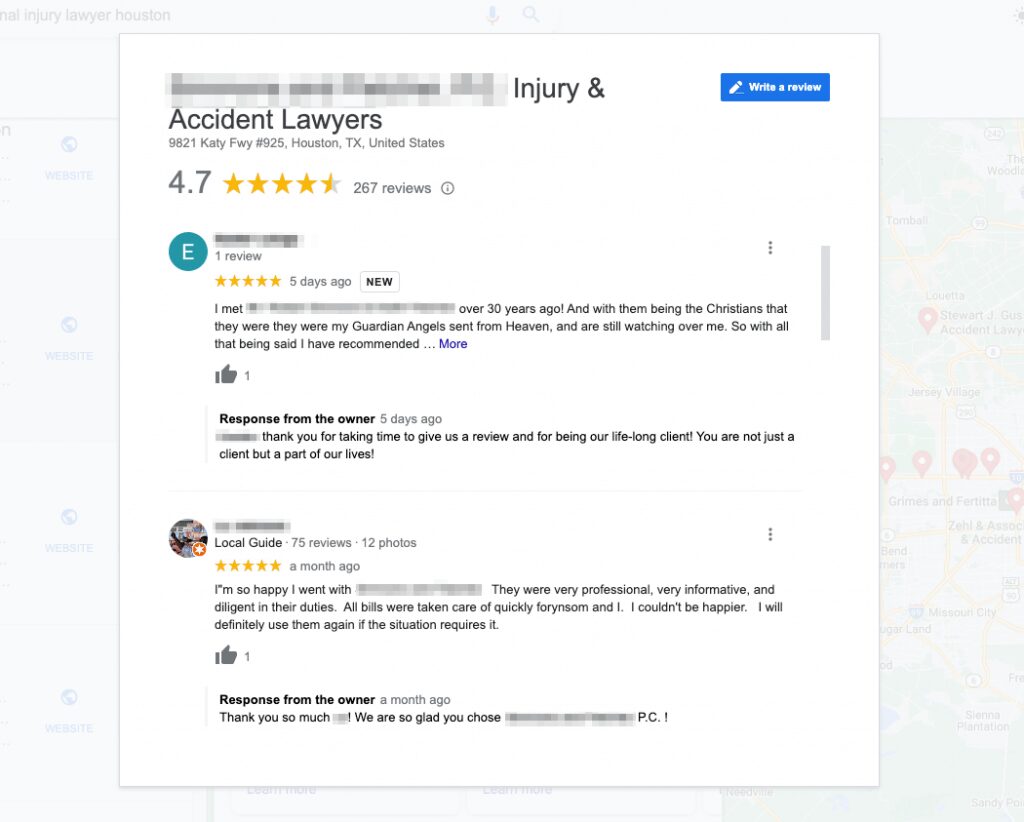
Google reviews are one of the strongest trust signals available to Ottawa lawyers — they provide third-party evidence that real clients have trusted the firm, at the exact moment a prospective client is deciding whether to reach out.
What Pages Matter Most for Law Firm Lead Generation
Not all pages on a law firm website contribute equally to generating consultation requests. For most Ottawa law firms, these are the highest-impact pages:
Practice area pages. Where most organic search traffic lands. Where most conversion decisions are made. Each practice area page needs to answer the visitor’s specific question, build credibility for that specific matter, and make reaching out feel like the obvious next step. A family law page should convert family law clients. A criminal defence page should convert criminal defence clients.
Homepage. The overall first impression and credibility anchor. Should confirm practice areas, show trust signals, and present the primary call to action before the visitor has to scroll.
About / Lawyer bio pages. Where prospective clients evaluate the actual person they’ll be working with. Consistently among the most-visited pages on law firm websites. Real photos, genuine voice, and relevant credentials are essential.
Contact page. The final step before a consultation. Should be as frictionless as possible — short form, visible phone number, reassurance about confidentiality, clear indication of response time.
Common Reasons a Law Firm Website Gets Traffic but Not Inquiries
If your website has traffic but isn’t generating consultations, the issue is conversion — not visibility. These are the most common causes:
Homepage messaging is about the firm, not the client. Leading with history, philosophy, and credentials before explaining which situations you actually help with. Prospective clients need to recognise their problem on your website before they care about your background.
Calls to action are weak or missing. A “Contact” link in the navigation is not a call to action. Visible buttons with specific invitations — “Book a Free Consultation,” “Speak with a Lawyer Today” — need to appear throughout the site.
No practice-area-specific trust signals. A general testimonial on the homepage doesn’t reassure a prospective corporate client the way a specific commercial law testimonial would. Match trust signals to the relevant practice area pages.
The contact form asks too much. Eight-field forms have far lower completion rates than three-to-five field forms. Collect additional information after you’ve established contact — not as the price of admission.
Mobile experience is poor. The phone number isn’t tappable. The form is difficult to complete on a small screen. The text requires pinching and zooming. These issues silently eliminate a significant share of mobile visitors before they ever reach a decision point.
Our guide on how to get more clients from your website covers the conversion side of this diagnosis in detail — including a practical checklist for identifying exactly where your site is losing people.
Visibility vs. Conversion: Diagnosing the Real Problem
Before investing in any solution, it’s worth understanding which problem you actually have.
You have a visibility problem if:
- Your website receives fewer than 100–200 visitors per month from organic search
- Your law firm does not appear in the local map pack for your primary practice area searches
- Searching your own services on Google doesn’t surface your website in the first two pages
You have a conversion problem if:
- Your website receives reasonable traffic but generates very few consultation requests
- People visit multiple pages but don’t fill out forms or call
- Your GBP receives views but few clicks to your website
You likely have both if:
- Traffic is low AND the traffic you do receive doesn’t convert
- Your GBP is incomplete or inactive AND your website has weak messaging
Check Google Search Console for traffic data and Google Analytics for on-site behaviour. These two free tools together give you enough information to accurately diagnose whether visibility, conversion, or both need attention.
Do You Need Paid Ads, or Will Website and SEO Improvements Help First?
Paid ads — Google Ads in particular — can generate legal inquiries quickly. But they are expensive in the legal sector, stop generating results the moment you stop paying, and work best when they send traffic to a website that already converts well.
The strongest law firm marketing strategies don’t start with ads — they start with a website that converts and a Google presence that builds visibility organically before any paid budget is added.
For most Ottawa law firms that haven’t yet invested in a properly structured website and local SEO, the right order is:
- Fix the website structure and messaging so it converts visitors into consultations
- Optimize the Google Business Profile for map pack visibility
- Build organic rankings through practice area pages and content
- Consider paid ads once the foundation is converting traffic effectively
Spending on ads before fixing a low-converting website is one of the most common and costly mistakes in legal marketing. You get more traffic — into the same experience that wasn’t converting in the first place.
The Law Firm Online Presence Checklist
Website:
- [ ] Homepage headline names the practice area and client situation — not just the firm name
- [ ] Primary CTA visible before scrolling on homepage
- [ ] Phone number tappable and visible at the top of every page
- [ ] Dedicated page for every practice area offered
- [ ] Short contact form (five fields or fewer)
- [ ] Lawyer bios with real photos, year of call, and practice focus
- [ ] Testimonials displayed on homepage and relevant practice area pages
- [ ] Mobile-friendly layout confirmed
- [ ] PageSpeed score above 70 on mobile — test at Google PageSpeed Insights
Google Business Profile:
- [ ] Profile claimed and verified
- [ ] Most specific primary category selected (not just “Lawyer”)
- [ ] Business description mentions practice areas and Ottawa service area
- [ ] 10+ real photos uploaded
- [ ] Review collection process in place
- [ ] All reviews responded to professionally
Local SEO:
- [ ] Sitemap submitted to Google Search Console
- [ ] NAP consistent across website, GBP, and legal directories
- [ ] Listed on Avvo, Justia, FindLaw, and LSO Find a Lawyer
- [ ] Performance monitored monthly in Search Console
Conversion tracking:
- [ ] Google Analytics installed and tracking visitors
- [ ] Form submissions tracked as goal completions
- [ ] Phone clicks tracked on mobile
Frequently Asked Questions
How long does it take for an Ottawa law firm to see results from improving their online presence?
It depends on where you’re starting. Fixing your website messaging and GBP can produce an increase in consultation requests relatively quickly — sometimes within weeks — because those improvements affect every visitor from the moment they go live. SEO improvements that target organic search rankings typically take three to six months to produce meaningful visibility movement, and six to twelve months to deliver consistent results for competitive practice area keywords. The businesses that see the strongest long-term results treat their online presence as an ongoing investment rather than a one-time project.
Should a law firm invest in SEO before fixing the website?
No. Driving more traffic to a website that doesn’t convert is one of the most common and expensive mistakes in legal marketing. Fix the website structure, messaging, and calls to action first. Then invest in SEO to bring more of the right traffic to a site that is already working. Our post on how to get more clients from your website covers how to identify and fix the specific points where a website is losing potential clients.
How many Google reviews does an Ottawa law firm need to be competitive?
It depends entirely on your competitors. Search your primary practice area plus Ottawa on Google and look at the review counts of the top three firms in the local map pack. That’s your target. In most Ottawa legal markets, 30–60 recent reviews with a rating above 4.5 puts a firm in a strong competitive position. Recency matters as much as total count — ten reviews from this month carry more weight than fifty from three years ago. Our guide on how to optimize your Google Business Profile covers review strategy in the context of full GBP optimization.
What is the most important thing a law firm website can do to generate more consultations?
Make it immediately clear what type of legal situations you handle, and make reaching out feel easy and low-risk. Most law firm websites fail at the first part — burying practice areas behind general messaging about the firm — and underperform at the second, by hiding contact information or creating friction in the intake process. A homepage headline that names your practice area and your Ottawa client base, followed by a visible “Book a Free Consultation” button, does more for consultation generation than almost any other single change.
Is it worth having a blog on a law firm website?
Yes, but only if maintained consistently. A blog that covers Ontario-specific legal questions — “what happens to the family home in an Ontario divorce,” “what are my rights after a wrongful dismissal in Ottawa” — captures long-tail search traffic from prospective clients in the research phase and builds topical authority over time. The risk is an abandoned blog with the last post from two years ago, which signals stagnation. If a consistent publishing schedule isn’t realistic, focus on making existing practice area pages comprehensive and thorough before adding a blog. Our post on SEO for law firms in Ottawa explains how content strategy fits into a broader law firm SEO approach.
Can a small solo law practice compete online with larger Ottawa firms?
Absolutely — and often more effectively than many solo lawyers expect. Larger firms spread their content and marketing efforts across more practice areas, which dilutes focus. A solo practitioner who specialises in one or two areas of law can build highly specific, deeply authoritative content and a strongly optimized GBP for those areas. Neighbourhood-level targeting — “family lawyer Barrhaven” or “estate lawyer Nepean” — is also far less competitive than city-wide keywords and often converts better because the searcher is looking for someone local and accessible.
Conclusion: A Stronger Online Presence Turns More Searchers Into Consultations
Ottawa lawyers don’t lose potential clients because they’re less capable than competitors. They lose them because their online presence — the website, the Google Business Profile, the reviews, the messaging — isn’t working as hard as it could.
The firms consistently generating consultation requests from Google have invested in the full picture: a website that answers the right questions fast and builds enough trust to prompt action, a Google Business Profile that earns map pack visibility, and a local SEO strategy that connects their practice areas to the searches Ottawa clients are actually making.
None of that requires a massive budget or a marketing department. It requires the right foundations, applied consistently over time.
At Ottawa Web Genius, we work with Ottawa law firms on both sides of this equation — the website that converts, and the local visibility that feeds it. If your firm isn’t generating the consultation volume it should be, we’re happy to have a straightforward conversation about what’s holding it back.
Explore our web design and SEO services or reach out directly to discuss what your practice’s online presence needs.