
Web Design For Law Firms in Ottawa
Introduction: A Prospective Client Is Judging Your Firm Before You Know They Exist
When someone in Ottawa needs a lawyer, they don’t ask around first anymore. They search Google. They look at who comes up, they scan the website for about thirty seconds, and they make a quiet decision about whether that firm feels credible enough to contact.
That decision happens before you ever pick up the phone.
For law firms, a website isn’t a digital business card — it’s a credibility filter. It’s the thing that converts a stranger’s legal problem into an inquiry to your firm. And the gap between a law firm website that generates steady client inquiries and one that quietly underperforms comes down to a handful of specific decisions made in the design and content phase.
This guide covers exactly what an Ottawa law firm website needs — from structure and content to trust signals and local SEO — in plain, practical terms.
Why Most Law Firm Websites Don’t Convert
The most common law firm website problem isn’t bad design. It’s a mismatch between what the firm wants to show and what a prospective client needs to know.
Many law firm websites lead with the firm’s history, awards, and philosophy. Prospective clients, especially those dealing with a stressful legal situation, want to know one thing first: can this firm help me with my specific problem?
The websites that convert — that actually turn visitors into calls and consultation requests — answer that question immediately and then build trust from there.
A well-designed Ottawa law firm website does three things reliably:
- Clearly communicates what practice areas the firm handles
- Builds enough trust that a stressed, uncertain prospective client feels confident reaching out
- Makes the next step (calling or submitting a form) obvious and frictionless
Everything else in the design supports these three outcomes.

A law firm website should project competence and approachability — two qualities prospective clients are evaluating before they make contact.
The Essential Pages Every Ottawa Law Firm Website Needs
Homepage
The homepage is where most prospective clients land first, and it needs to work hard in a short window of time.
A strong law firm homepage should include:
- A headline that immediately communicates who you help and what you do (not just your firm name)
- A brief statement of your areas of practice
- A clear primary call to action — “Book a Consultation” or “Call Us Today” — visible before scrolling
- Trust signals: years in practice, number of clients helped, languages spoken, associations
- A brief introduction to the lead lawyer or team
- Links to your main practice area pages
Avoid the temptation to make the homepage primarily about firm history. Context and credentials belong here, but they support the main message — they don’t replace it.
Practice Area Pages
This is the single most important structural decision in a law firm website, and the one most often done poorly.
Every area of law your firm handles needs its own dedicated page. If you’re a family law firm, you need separate pages for divorce, separation agreements, child custody, property division, and spousal support. If you practice criminal defence, each charge type deserves its own page.
The reasons are practical:
For SEO: When someone searches “divorce lawyer Ottawa” or “criminal defence Kanata,” Google matches that search to a specific page. A single catch-all “Our Services” page cannot compete against firms with dedicated, well-optimized pages for each practice area. This is one of the most significant lost opportunities we see on law firm websites, and it’s entirely fixable.
For clients: A prospective client dealing with a custody dispute doesn’t want to read about your tax law practice before finding what’s relevant to them. Dedicated pages let visitors self-identify and find what applies to their situation quickly.
Each practice area page should explain:
- What the area of law covers
- The situations and scenarios you typically handle
- What the process looks like (without giving specific legal advice)
- Why someone should choose your firm for this specific matter
- A clear call to action
About Page
People hire lawyers they trust. Trust requires familiarity. Your About page — especially if it includes individual lawyer bios — is where that familiarity begins.
An effective law firm About page includes:
- Individual bios for each lawyer, with a professional photo
- Education, bar admissions, and years of experience
- Personal context where appropriate — what drew them to this area of law, what clients they most enjoy helping
- Any notable case outcomes or recognitions (subject to Law Society guidelines)
- Languages spoken, which matters significantly in bilingual markets like Ottawa
Generic “our team is dedicated to excellence” language does nothing. Specific, genuine information about real people builds far more trust.
Contact Page
Your contact page should make it as easy as possible for a prospective client to take the first step — which for many people is already an anxious one.
Include:
- A simple contact form asking only for name, email, phone, and a brief description of their situation
- Your direct phone number, prominently displayed
- Your office address and a Google Map embed
- Office hours
- Languages available for consultation if relevant
- A reassuring line about confidentiality — “All inquiries are completely confidential”
The confidentiality note is specific to legal services and worth including. Many prospective clients hesitate because they worry about privacy. Addressing that directly reduces one more barrier to contact.
FAQ Page
An FAQ page is particularly valuable for law firms. Prospective clients search legal questions constantly — “how long does a divorce take in Ontario,” “what are my rights if I was wrongfully dismissed,” “do I need a lawyer for a will in Ottawa.”
If your FAQ page or practice area pages answer these questions well, they can appear in Google’s featured snippets and capture traffic from people actively researching their legal situation — the highest-intent audience available.
Trust Signals That Matter for Law Firm Websites
Trust is the conversion mechanism for legal services. Without it, no amount of traffic converts. These are the elements that build it most effectively:
Professional photography Stock photos of courtrooms and gavels do not build trust. Photos of your actual lawyers, your actual office, and your actual team do. Investment in professional photography pays back many times over on a law firm website.
Law Society membership and associations Display your Law Society of Ontario membership, any relevant bar associations, and specialty certifications clearly — in the footer, the About page, and on relevant practice area pages.
Client testimonials Subject to Law Society of Ontario advertising guidelines, testimonials are among the strongest trust signals a law firm can include. Even a handful of genuine client quotes, placed on the homepage and relevant practice area pages, significantly increase inquiry rates.
Case results or outcomes Where permitted and appropriately anonymized, sharing representative case outcomes — “negotiated a favourable settlement in a complex family property dispute” — demonstrates capability far more than a list of adjectives.
Years in practice and client numbers Concrete figures communicate stability. “Over 15 years serving Ottawa clients” or “more than 800 families helped” are more persuasive than vague statements of experience.
Local SEO for Ottawa Law Firms: Getting Found Before the First Click
A beautiful, well-structured website generates no inquiries if prospective clients can’t find it. Local SEO is what ensures your firm appears when Ottawa residents search for legal help.
Practice area pages with location references Each practice area page should naturally reference Ottawa, and where relevant, specific neighbourhoods or surrounding cities your firm serves. “Family lawyer serving Ottawa, Kanata, Orleans, and Nepean” is more locally relevant than a page with no geographic context.
Google Business Profile Your firm’s Google Business Profile is what powers your map pack appearance — the three businesses shown at the top of local search results. It should be fully completed with accurate contact details, the correct practice area categories, professional photos, and an active review collection process.
Ottawa-specific content Blog posts or resource articles addressing Ontario-specific legal questions — “What happens to the matrimonial home in an Ontario divorce?” or “Understanding Ontario’s Employment Standards Act” — build local relevance and capture searches from people in your market researching their situation.
For a complete picture of how local SEO works for Ottawa businesses, our local SEO guide for small businesses covers the full strategy in detail.
Google reviews Reviews are a significant ranking signal for local search. A law firm with 40 recent Google reviews will consistently outperform a competitor with 8, even if the competitor’s website is technically stronger. Building a consistent, ethical review-collection process is one of the highest-leverage things a law firm can do for local visibility. Our guide on how to get more Google reviews for your Ottawa small business covers exactly how to do this in practice.
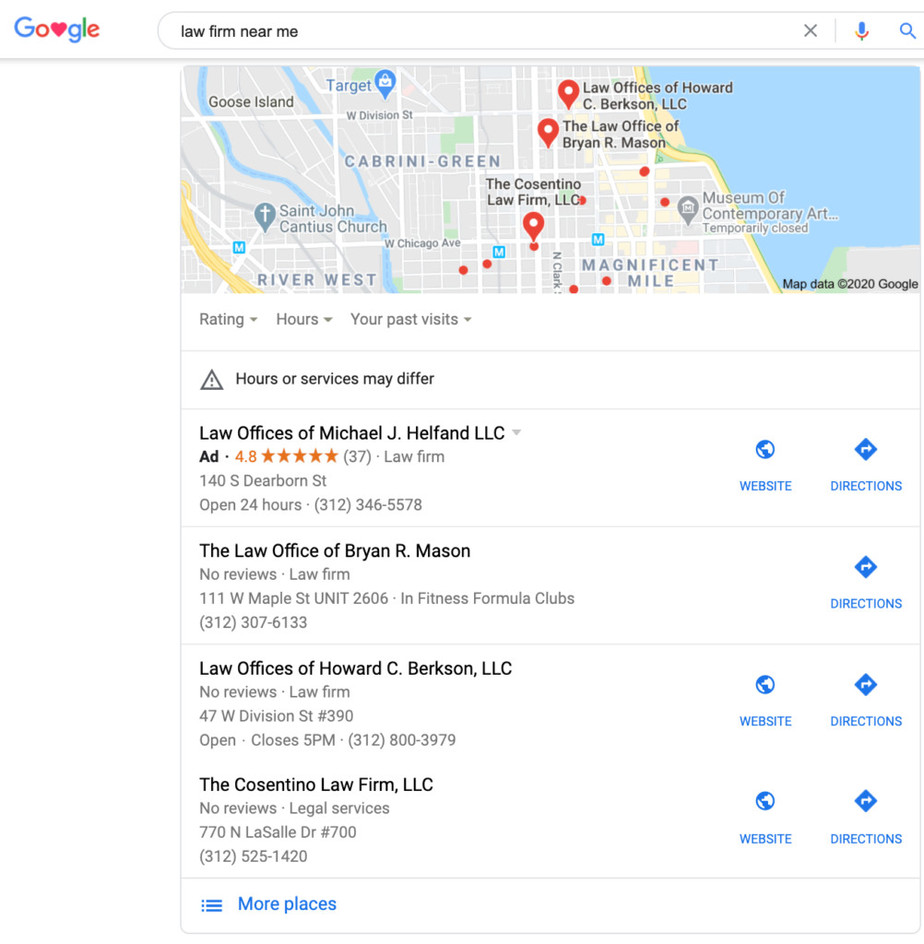
Appearing in Ottawa’s local map pack for practice-area searches is one of the highest-value outcomes of a well-optimized law firm website and Google Business Profile.
Mobile Performance and Site Speed: Non-Negotiable Basics
More than half of legal searches happen on mobile devices — often by people in stressful situations who want answers quickly. If your website loads slowly or displays poorly on a phone, those visitors leave before reading a word.
Google also uses mobile performance as a ranking signal. A slow, mobile-unfriendly website ranks lower regardless of content quality.
Every law firm website should:
- Load in under three seconds on a mobile connection
- Display clearly on all screen sizes without horizontal scrolling
- Have click-to-call buttons that work with a single tap
- Feature forms that are easy to complete on a small screen
You can check your current site performance at Google PageSpeed Insights — it’s free and gives specific recommendations.
What a Law Firm Website Should Not Include
Understanding what to leave out is as useful as knowing what to include.
Excessive legal jargon on client-facing pages Your prospective clients are not lawyers. Write practice area pages the way you’d explain the situation to a worried client sitting across the desk — clearly, reassuringly, without assuming prior knowledge.
Generic stock imagery A photo of a gavel on a wooden desk communicates nothing about your firm. Generic imagery makes your site look interchangeable with every other law firm website. Real photos of real people set you apart.
No clear calls to action Many law firm websites are beautifully written but never tell the visitor what to do next. Every page should end with a clear, low-pressure invitation to take action — “Book a Free Consultation” or “Call Us to Discuss Your Situation.”
Outdated content A blog post from 2019 referencing legislation that has since changed is actively harmful to your firm’s credibility. Either commit to keeping content current or focus on evergreen content that doesn’t date quickly.
The Must-Have vs. Nice-to-Have for Law Firm Websites
| Must-Have | Nice-to-Have |
|---|---|
| Homepage with clear positioning | Video introduction from the lead lawyer |
| Dedicated page per practice area | Online scheduling integration |
| Individual lawyer bios with photos | Client portal or document portal |
| Contact page with form and phone | Live chat |
| Google Business Profile linked | Blog with Ontario legal resources |
| Mobile-friendly, fast loading | Multiple language versions |
| Basic local SEO on all pages | Downloadable guides or resources |
| SSL certificate (HTTPS) | Case study or outcome pages |
Frequently Asked Questions
How many pages does a law firm website need?
It depends on your practice areas, but most Ottawa law firms benefit from a minimum of eight to twelve pages: a homepage, an about page, individual bios, a contact page, a dedicated page per core practice area, and an FAQ page. Firms with multiple lawyers and broader practice areas often benefit from twenty or more pages — each one targeting a specific service and search intent.
Should a law firm website have a blog?
A blog is a strong long-term investment for law firms, but only if maintained consistently. Ontario-specific legal content — explaining family law processes, landlord-tenant rights, employment law updates — captures high-intent search traffic from people actively researching their situation. The risk is an abandoned blog with outdated posts, which can harm credibility. If you’re not committed to regular publishing, focus first on making your practice area pages comprehensive before adding a blog.
Can a law firm display client testimonials on their website?
Yes, but subject to the Law Society of Ontario’s advertising guidelines. Testimonials are permitted when they are genuine, not misleading, and don’t create unrealistic expectations about outcomes. Testimonials that speak to the experience of working with the firm — responsiveness, clarity, professionalism — rather than specific legal results are generally safe ground. Always review current LSO guidelines before publishing.
How important is Google ranking for a law firm in Ottawa?
Extremely important. Most prospective clients in Ottawa begin their search for legal help on Google — not through referral directories, not through social media. A firm that consistently appears in the top local search results for their practice areas has a significant and compounding advantage over competitors who don’t. This is why investing in both website quality and local SEO is one of the highest-return decisions an Ottawa law firm can make.
How long does it take to build a professional law firm website?
A well-built law firm website — with proper discovery, copywriting, design, development, and SEO setup — typically takes four to eight weeks from kickoff to launch, depending on the number of pages and the speed of content approval on the firm’s end. Rushing the process typically produces a site that underperforms. The content development phase, particularly writing clear and persuasive practice area pages, is often the most time-intensive element.
What makes Ottawa Web Genius a good fit for law firm websites?
We’ve built websites for Ottawa law firms including J. Solomon Law, and we understand both the design expectations and the specific sensitivity that legal clients bring to their online experience. Every website we build includes local SEO foundations, proper page structure, and conversion-focused copywriting — not just a visual template dropped onto your practice area list. See our web design and SEO services or view our pricing to get a clear picture of what’s involved.
Conclusion: Your Website Should Be Working as Hard as Your Team
An Ottawa law firm website that’s built around client needs — clear practice area pages, genuine trust signals, easy contact options, and solid local SEO — doesn’t just look professional. It consistently converts the right people into consultation requests.
The firms that show up reliably at the top of Ottawa legal searches, that generate a steady flow of qualified inquiries, have invested in getting this right. Not because they spent the most money, but because their website was built with the client experience and search visibility in mind from the start.
If your current website isn’t generating the inquiries your firm deserves — or if you’re planning a new site and want to get it right — we’d welcome a straightforward conversation about what that looks like.
Explore our web design services or get in touch with Ottawa Web Genius to discuss your firm’s specific needs.