Google Ads vs SEO: Which Gets More Leads in Ottawa?
An Ottawa contractor has $1,500 per month for marketing. They want more quote requests. Should they buy visibility immediately through Google Ads, or invest in SEO that takes months to build?
Here is the direct answer:
If you need leads this month, Google Ads generally has the advantage. A properly configured campaign can start generating clicks quickly after launch.
If you want to build Google visibility that does not disappear the moment you stop paying, SEO generally has the advantage. It takes longer but creates assets that can generate leads beyond the month they were produced.
If the business economics support it, using both strategically can be stronger than treating Google Ads vs SEO for small business as a competition between two incompatible options.
Neither strategy guarantees leads. Both require a website that can actually convert visitors into enquiries before either channel can produce meaningful results.
Google Ads vs SEO for Small Business: Quick Comparison
| Factor | Google Ads | SEO |
|---|---|---|
| Speed | Can generate clicks quickly after launch | Usually takes months for meaningful results |
| Traffic source | Paid clicks | Organic search |
| Cost model | Pay per click plus management | Ongoing investment in strategy, content, and technical work |
| Stops when spending stops? | Paid visibility generally stops | Existing rankings may continue, but can decline |
| Long-term compounding | Limited | Stronger potential |
| Control | High (keywords, budget, targeting) | Lower |
| Testing speed | Fast | Slower |
| Local visibility | Paid ads in search results | Map pack, organic results, GBP |
| Best use case | Immediate demand, testing, specific campaigns | Long-term visibility, authority, cost per lead reduction |
Neither channel automatically outperforms the other. The right answer depends on your business situation, budget, margins, urgency, and website quality.
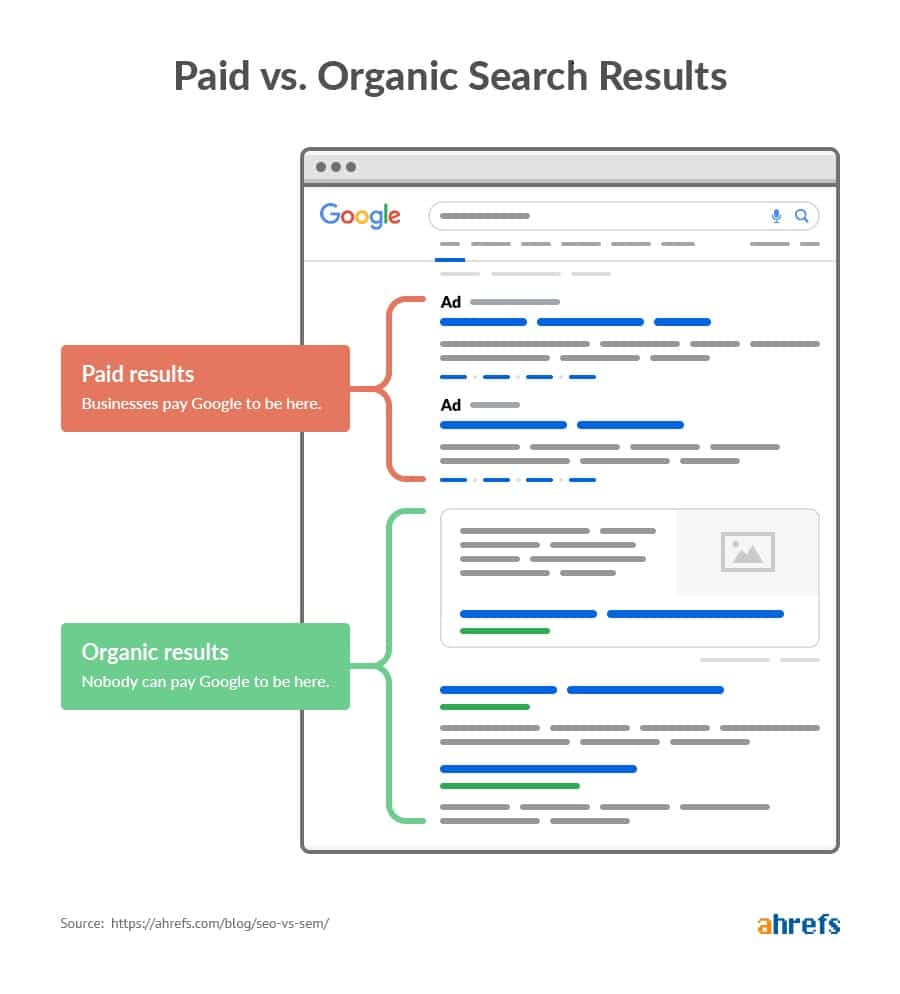
Google Ads buys immediate visibility while a campaign is running. SEO builds visibility that can continue generating traffic beyond the period of active investment. Both require a website that converts visitors into leads.
How Google Ads Generates Leads
The journey looks like this:
Search: “basement insulation Ottawa”
|
Google shows paid ad at the top of results
|
Potential customer clicks the ad
|
Landing page (a webpage designed to generate a specific action)
|
Phone call or form submission
Key terms explained:
Keywords are the search phrases you tell Google your ad should appear for. “Basement insulation Ottawa” and “Ottawa insulation contractors” are examples of keywords a contractor might target.
Cost Per Click (CPC) is the amount you pay each time someone clicks your ad. CPC varies significantly by industry and keyword competition. A click for “emergency plumber Ottawa” will cost more than a click for a low-competition search because more businesses are bidding on it. CPC rates change constantly based on auction dynamics.
Quality Score is a rating Google uses to assess the relevance between your keywords, ads, and landing pages. A higher Quality Score can result in better ad positions at lower costs.
Conversion rate is the percentage of visitors who take the action you want, such as calling or submitting a form. If 100 visitors arrive and 5 call, the conversion rate is 5 percent.
Paying for clicks does not guarantee leads. If the landing page is unclear, slow, or does not give visitors a reason to contact you, Ads can generate clicks and no enquiries simultaneously. The click is purchased. The lead still has to be earned.
Properly configured Google Ads campaigns also require ongoing management: reviewing which search terms triggered your ads, pausing keywords that attract the wrong searches, refining ad copy, and adjusting bids. This is either a time investment or an agency fee on top of your ad spend.
How SEO Generates Leads
The journey looks like this:
Search: “estate lawyer Ottawa”
|
Organic search result or local map pack result
|
Website
|
Service page (a page specifically about that legal service)
|
Phone call or consultation request
SEO is not free traffic. Businesses invest in it through:
- Time spent creating and updating content
- Technical SEO work (fixing site speed, indexing, page structure)
- Content strategy and writing
- Local SEO and Google Business Profile management
- Link acquisition and authority building
- Professional SEO services where applicable
Key components of SEO:
On-page SEO refers to how each page of your website is structured and written. Title tags, headings, content depth, internal links, and page speed all contribute to how Google evaluates and ranks pages.
Local SEO focuses on visibility in geographically relevant searches, which for most Ottawa service businesses means appearing in the local map pack and organic results for Ottawa-specific queries.
Google Business Profile (GBP) is the free listing that powers your appearance in Google Maps and the local pack. An optimised GBP is one of the most direct levers for local search visibility.
Backlinks are links from other websites pointing to yours. Google uses these as signals of credibility and authority. A page with more relevant, authoritative backlinks typically ranks higher than a comparable page with fewer.
Google Ads vs SEO for Small Business: Which Gets Leads Faster?
Google Ads.
A properly configured campaign can begin generating impressions and clicks quickly after launch. However, there is an important distinction between traffic, leads, and profitable leads.
A newly launched campaign can generate clicks on day one. It may take weeks or months of optimisation before the cost per lead becomes acceptable and the lead quality matches what the business actually needs.
SEO has a different timeline. Realistic expectations for an Ottawa service business:
- Early movement: 1 to 3 months (improved indexing, initial rankings on lower-competition searches)
- Meaningful local visibility: 3 to 6 months
- Competitive Ottawa markets: 6 to 12 months or longer
These are ranges based on general SEO experience, not guarantees. Starting conditions matter significantly. A website with strong technical foundations, existing domain history, and some content will typically move faster than a brand new domain with no existing presence.
How Much Does Google Ads Cost for an Ottawa Small Business?
The total cost of Google Ads has three components:
Ad spend: The budget paid directly to Google for clicks.
Management: The cost to set up and manage campaigns, whether in-house time or agency fees.
Landing page and conversion work: Where the existing website cannot convert clicks into enquiries, additional investment in landing pages or website improvements may be required.
CPC varies significantly by industry, keyword, location, and competition. Rather than providing average figures that would quickly become inaccurate, here is how to think about budget scenarios:
$500 per month ad spend This may generate a modest number of clicks in lower-competition markets or for specific, targeted keywords. In highly competitive Ottawa industries like HVAC, roofing, or law, $500 in ad spend may produce limited results and may not be enough to generate reliable data for optimisation.
$1,000 to $1,500 per month A more workable budget for local service businesses in moderate-competition markets. Enough to generate a pattern of clicks and some enquiries, and enough data to optimise the campaign meaningfully.
$2,000 to $3,000+ per month More appropriate for competitive industries or businesses targeting high-value searches across multiple Ottawa service areas. At this level, Ads can function as a reliable acquisition channel provided the conversion economics work.
Budget viability depends on:
- Lead value (a roofing job worth $8,000 justifies more ad spend per lead than a $150 cleaning service)
- Conversion rate of your website or landing page
- How often leads become paying customers
- The cost of the keywords you need to appear for
Use Google Ads Keyword Planner to research estimated CPC ranges for your specific keywords before committing to a budget.
How Much Does SEO Cost in Ottawa?
SEO investment varies based on scope, competition, and how much work the website requires.
Common pricing structures:
Monthly retainer: The most common arrangement for ongoing local SEO. Ottawa agencies and freelancers typically offer monthly retainers that cover keyword targeting, content, technical work, GBP management, and reporting. Pricing varies significantly depending on scope and provider experience.
Project-based SEO: A defined scope of work completed for a fixed price, such as an SEO audit, a website technical cleanup, or a set of optimised service pages.
Local SEO packages: Focused specifically on Google Business Profile, local citations, and neighbourhood-level visibility. Often the right starting point for businesses with limited budgets in lower-competition markets.
SEO scope expands with:
- Number of services and service pages required
- Level of competition in the industry and location
- Current condition of the website (technical problems, thin content, poor structure)
- Content needed to build topical authority
- Backlink profile and authority gaps relative to competitors
Our SEO pricing guide for Ottawa businesses covers realistic cost ranges and what different investment levels typically deliver.
The Numbers That Actually Matter
This section is where the Google Ads vs SEO for small business debate becomes concrete.
Hypothetical Ottawa contractor example (illustrative only, not a market average):
| Metric | Value |
|---|---|
| Monthly ad spend | $1,500 |
| Estimated clicks | 150 |
| Conversion rate (leads from clicks) | 10% |
| Leads generated | 15 |
| Lead-to-customer rate | 33% |
| Customers acquired | 5 |
| Average job value | $2,000 |
| Gross revenue from Ads | $10,000 |
| Ad spend as % of revenue | 15% |
Whether those economics make Ads worthwhile depends on the profit margin on that $2,000 job, the management cost added on top, and what the alternative use of that $1,500 would produce.
Cheaper clicks do not equal better marketing. A campaign generating 200 clicks per month from searchers who are not the right fit, in the wrong area, or searching for information rather than a contractor produces poor economics regardless of the low CPC.
The question is not how many clicks you can buy. The question is whether the business is acquiring profitable customers at a cost that makes sense given its margins.
Google Ads budget covers ad spend, management, and landing page costs. SEO budget covers strategy, technical work, content, local SEO, and authority building. Neither channel produces leads without investment in what happens after the click.
SEO Economics Work Differently
SEO investment is harder to evaluate month to month because the return is not immediate and not as directly traceable as an ad click.
A business that invests in SEO for 12 months may see limited returns in months one through three, more meaningful returns in months four through eight, and genuinely compounding returns in months nine through twelve and beyond.
The pages, content, and authority built during that investment period may continue generating traffic after active investment is reduced or paused. That is the compounding dynamic that makes SEO valuable over time.
However, avoiding a common misleading claim is important here: SEO does not produce rankings that last forever. Competitors continue improving. Google updates its algorithm regularly. Content becomes outdated. Websites change. A business that stops all SEO activity will typically see rankings decline over time as competitors who continue investing pull ahead. SEO requires ongoing maintenance, not just an initial investment.
What Happens When You Stop Paying?
Google Ads: When campaigns are paused or budgets are removed, paid visibility generally stops. The ads stop appearing. The clicks stop. The leads from that channel stop.
SEO: Stopping active SEO work does not immediately remove existing rankings. A page that ranks well today may continue ranking for some time without active maintenance. However, the factors that pushed it down will accumulate over time: competitors improving, content becoming stale, technical issues developing, and Google’s changing evaluation of relevance.
The asset-like nature of SEO rankings is real. But so is their eventual decay without maintenance.
One thing I have noticed working with Ottawa service businesses is that business owners often underestimate how quickly rankings can be displaced in competitive markets when a competitor begins active SEO investment while the incumbent stays static.
Which Is Better for Local Ottawa Searches?
A Google search results page for a local Ottawa query can contain several distinct opportunities simultaneously.
Search “renovation contractor Barrhaven” and you may see:
- Paid ads at the top (Google Ads)
- A local map pack showing three businesses with ratings (driven by Google Business Profile and local SEO)
- Organic results below the map pack (driven by website SEO)
A business with strong local SEO and a well-optimised GBP can potentially appear in both the map pack and the organic results. Adding a Google Ads campaign creates the possibility of appearing in paid ads as well. This is one reason combining channels can create broader search visibility in Ottawa local searches.
Our guide on how to rank higher on Google Maps in Ottawa covers the local map pack specifically. It is worth optimising regardless of which primary channel you invest in, since GBP optimisation costs significantly less than either a major Ads campaign or comprehensive SEO.
Ottawa Market Competition Matters
A $1,000 marketing budget produces completely different economics depending on the industry.
Higher competition, higher cost per click:
- Law firms (especially personal injury, family law)
- HVAC and emergency home services
- Roofing and siding
- Dental offices
- Restoration companies
In these industries, a $1,000 monthly ad spend may generate a limited number of clicks. The economics of Ads may require a higher budget to work, making SEO a proportionally more valuable investment.
Moderate competition, more budget flexibility:
- Renovation contractors
- Accountants and financial advisors
- General cleaning and janitorial
- Landscaping
Geographic targeting matters. A plumber targeting searches in Kanata, Nepean, and Barrhaven simultaneously may need more budget than one focused specifically on a single area. Narrower geographic targeting can reduce competition and CPC in some cases. A restaurant in Orléans competing for “restaurant near me” searches faces different economics than one in Westboro, where the dining market is denser and search competition is higher.
Five Ottawa Business Scenarios
Scenario 1: New Business That Needs Leads Now
A new Ottawa contractor with no existing organic visibility, a recently launched website, and an immediate need for work.
Likely recommendation: Google Ads as the primary lead channel, with foundational SEO established simultaneously if budget allows.
Why: SEO on a new domain will not produce meaningful results quickly enough to serve the immediate need. Ads can generate clicks and test which services and messages resonate, providing data that will also inform the SEO strategy over time.
Scenario 2: Established Business Entirely Dependent on Google Ads
An Ottawa service business generating leads but spending heavily on Ads with no SEO investment. Every lead costs a fixed amount that does not decrease over time.
Recommendation: Begin investing in SEO to build an organic acquisition channel that can diversify lead sources over time.
The Ads can continue generating leads while SEO builds. Over 12 to 24 months, increasing organic traffic may allow some reduction in Ads spend without a corresponding reduction in leads.
Scenario 3: Small Business With $500 Per Month
Be realistic here. Spreading $500 across Google Ads, SEO, social media, and content will likely produce nothing useful in any channel.
The better approach: Choose one primary channel and do it properly.
If the business needs leads immediately and the service value is high enough to justify the CPC, a tightly targeted Ads campaign on a few high-intent keywords may generate some results. If urgency is lower, $500 per month invested in local SEO, a proper Google Business Profile, and consistent review acquisition may produce more sustainable results. If the website does not currently convert visitors into enquiries, fixing the website may be the highest-priority investment before either Ads or SEO.
Scenario 4: Ottawa Law Firm
Legal is one of the most competitive local search markets in Ottawa. CPC for high-value legal keywords can be significant. A family law firm or personal injury practice with strong margins may have the economics to support Google Ads. However, searchers for legal services often conduct significant research before contacting any firm.
A combined approach with different jobs for each channel: Ads for immediate visibility on high-intent searches (people searching for a specific legal service right now). SEO for building authority through practice area pages and educational content that captures earlier-stage research searches. Our guide on SEO for law firms in Ottawa covers the SEO layer specifically.
Scenario 5: Emergency Home Service Business
A plumber, HVAC company, restoration contractor, or emergency electrician in Ottawa.
Google Ads is particularly valuable here. Emergency searches are high-intent and time-sensitive. The person searching “emergency plumber Ottawa” at 11pm is not doing research. They need someone now. Being present at the top of that result, with a click-to-call phone number, can produce immediate business.
SEO is also valuable for these businesses but works on a different set of searches: people planning ahead, comparing options, or looking for maintenance services rather than emergencies.
Comprehensive Comparison Table
| Factor | Google Ads | SEO |
|---|---|---|
| Speed to first results | Can generate clicks quickly after launch | Typically months for competitive terms |
| Cost structure | Ad spend plus management | Strategy, content, technical, local SEO, authority |
| Long-term value | Limited without continued spend | Can compound over time |
| Control | High (keywords, budget, timing, targeting) | Lower (Google decides rankings) |
| Keyword targeting | Precise | Research-driven, less direct |
| Testing speed | Fast (can test messages and offers quickly) | Slower feedback loops |
| Trust signals | Some users skip ads | Organic results often perceived as more credible |
| Local visibility | Paid ads, local service ads | Map pack, organic results, GBP |
| Scalability | Scales with budget | Scales with content and authority over time |
| Measurement | Clear click and conversion tracking | Attribution can be less direct |
| Website requirements | Needs converting landing page | Needs strong content and technical foundation |
| Best use case | Immediate demand, testing, high-intent searches | Long-term visibility, authority, compounding leads |
Google Ads Has One Significant Advantage: Data Speed
Google Ads can quickly reveal information that takes much longer to gather through SEO alone:
- Which keywords people actually click when searching for your service
- Which ad messages generate higher engagement
- Which landing page variations convert more visitors
- Which locations and times of day produce the most leads
When I look at Ads and SEO, I do not really see them as competitors. One mistake I see businesses make is judging Ads purely by clicks rather than by actual calls and enquiries. The same data that reveals which ads work can also inform which service page headlines to test, which offers resonate, and where local SEO effort is most worth concentrating.
According to Google Ads Help documentation, campaigns allow granular control over targeting and bidding, and the performance data is available in near-real-time. This is a genuine analytical advantage.
SEO Has One Significant Advantage: Compounding Assets
SEO investment creates things that continue producing value:
- Service pages that rank and generate organic traffic month after month
- Educational content that captures research-stage searches
- Internal link structure that distributes authority across the site
- A Google Business Profile that earns consistent visibility without per-click cost
- Website authority that makes future pages rank faster than earlier ones did
These assets do not produce unlimited returns forever without maintenance. But a well-executed SEO campaign from 18 months ago may still be generating leads today. The same cannot generally be said for a Google Ads campaign from 18 months ago that was paused.
Neither Google Ads Nor SEO Can Fix a Bad Website
This is worth being direct about.
Google Ads can bring visitors to your website. SEO can bring visitors to your website. Neither strategy converts those visitors into customers. The website does that.
A site with weak messaging, no visible phone number, a slow mobile experience, confusing navigation, or no clear call to action will underperform regardless of how the traffic arrives. One mistake I see businesses make is increasing ad spend when enquiries are low, when the actual problem is that visitors are arriving and leaving without converting.
Before significantly increasing investment in either channel, it is worth answering: if 100 visitors land on your site today, how many will contact you? If the honest answer is very few, the highest-priority investment may be fixing the website, not increasing ad spend or SEO budget.
Our post on how to get more clients from your website covers the specific conversion problems that prevent website traffic from becoming leads.
Should You Run Google Ads and SEO at the Same Time?
Often yes, if the budget supports doing both properly.
A practical model:
Short term: Google Ads generates immediate visibility and leads while providing data on which keywords and messages convert.
Medium term: SEO begins building organic rankings, informed partly by what Ads data revealed about high-performing search terms.
Long term: Organic traffic becomes a growing acquisition channel. Ads can be focused more selectively on high-value, time-sensitive, or high-competition searches where paid presence still makes economic sense.
However, doing both poorly is worse than doing one well. A business with $800 per month to allocate across both channels may find it more effective to concentrate that budget on one channel until it is working before adding the second.
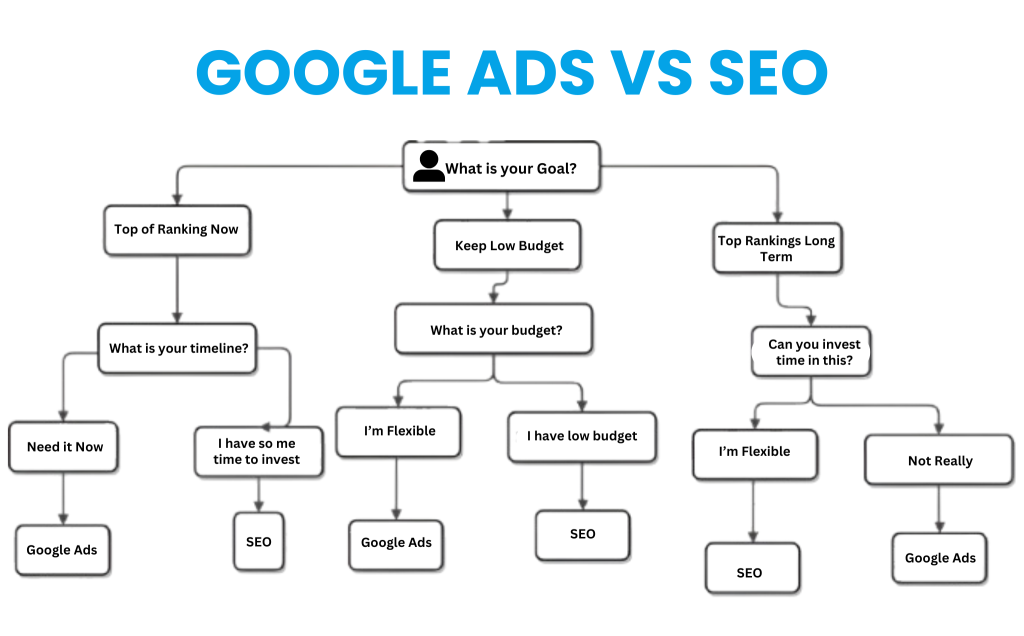
The right channel depends on urgency, budget, competition, website quality, and business economics, not a universal rule about which is better.
A Practical Decision Framework: Where Should Your Next $1,000 Go?
Do you need leads this month?
Yes: Google Ads deserves serious consideration as the primary starting channel.
No: SEO may be the better long-term investment depending on your situation.
Can your website currently convert visitors into enquiries?
No: Fix the website or landing page before significantly increasing spend on either channel. More traffic into a poor experience produces more waste, not more leads.
Are you already heavily dependent on Google Ads?
Yes: SEO investment is worth considering to diversify your acquisition channels and reduce cost per lead over time.
Is your Google Business Profile weak or incomplete?
Yes: Local SEO and GBP optimisation may offer the fastest return relative to cost, particularly for searches where the map pack captures significant clicks.
Do you know what a customer is worth to your business?
No: Establish basic tracking and understand your customer economics before significantly increasing spend. Without knowing what you can afford to pay per customer, neither channel can be evaluated properly.
Does your budget allow both to be done properly?
Yes: A combined strategy with Ads for immediate demand and SEO for compounding visibility is often the strongest long-term approach.
No: Choose the channel that fits your urgency, margins, and business stage. Do it properly before expanding.
90-Day Action Plan
Weeks 1 to 2:
- Set up Google Search Console and Google Analytics if not already in place
- Conduct a basic website audit (speed, mobile experience, conversion elements)
- Research keywords for both Ads and SEO
- Review and improve your Google Business Profile
- Analyse what competitors are doing in both paid and organic search
Weeks 3 to 4:
- Launch or refine a Google Ads campaign on your highest-intent, highest-value keywords
- Fix the most critical conversion problems on your website
- Begin foundational SEO work: title tags, meta descriptions, service page structure
Month 2:
- Review Google Ads search terms report to identify which searches are actually triggering your ads
- Improve landing pages based on performance data
- Publish or optimise priority service pages for SEO
- Strengthen local visibility through GBP activity and review collection
Month 3:
- Compare ad spend, leads generated, lead quality, and cost per acquisition
- Review early organic search data in Search Console for impression and click trends
- Assess what is working and adjust budget allocation based on actual data
- Decide whether to continue current split, increase one channel, or reduce the other
For a deeper look at what the SEO portion of this timeline actually looks like, our post on how long does SEO take for Ottawa small businesses covers realistic expectations at each stage.
Frequently Asked Questions
Is SEO better than Google Ads for small businesses?
Neither is universally better. Google Ads generates faster results when campaigns are properly configured. SEO builds more durable visibility over time. The right answer depends on your urgency, budget, industry competition, and customer economics. A business that needs leads this month and has the budget to support a viable ad campaign may be better served by starting with Ads. A business building long-term search visibility with a 12-month horizon may find SEO delivers stronger cumulative returns.
How much should an Ottawa small business spend on Google Ads?
There is no universal answer, and any source providing a specific average CPC for your industry without knowing your exact keywords, location, and competition is making a rough estimate at best. Use Google Ads Keyword Planner to research the estimated CPC ranges for your specific keywords. Then determine whether your customer value and conversion rate make the economics viable at different budget levels. A useful minimum is typically enough budget to generate at least 100 to 200 clicks per month so you have enough data to optimise.
How long does SEO take to generate leads?
For most Ottawa service businesses, the realistic timeline is 3 to 6 months for meaningful visibility on secondary keywords, and 6 to 12 months for competitive primary keywords. These are ranges, not guarantees. Starting conditions including domain age, existing content, technical health, and competition all affect how quickly SEO produces results. For a full breakdown of what to expect at each stage, our SEO timeline guide for Ottawa businesses provides a realistic month-by-month picture.
Should I do SEO and Google Ads at the same time?
Often yes, if the budget supports doing both properly. The strongest long-term strategy for many established Ottawa service businesses is Ads for immediate demand and SEO for compounding organic visibility. However, spreading a limited budget thinly across both channels can result in doing neither effectively. If budget is constrained, concentrate on one channel first. Our local SEO guide for Ottawa covers the SEO foundation that supports both channels.
Does SEO reduce the need for Google Ads over time?
It can. As organic rankings improve and organic traffic becomes a more significant lead source, some businesses find they can reduce Ads spend without a proportional reduction in total leads. However, this rarely means eliminating Ads entirely. Most established businesses find ongoing value in Ads for high-intent keywords, competitive searches where even strong organic rankings do not capture the top position, and specific promotional campaigns. The goal is usually not to replace one channel with the other but to improve the economics of the overall lead acquisition mix.
Which gives a better ROI: SEO or Google Ads?
No honest answer applies universally. For some businesses, Google Ads produces a better return because the customer value is high, the conversion rate is strong, and the CPC is manageable relative to margins. For others, SEO produces a better long-term return because compounding organic traffic eventually generates leads at a lower ongoing cost per acquisition than Ads. According to Google Search Central’s guidance on how search works, organic ranking is determined by relevance and quality signals that cannot be bought directly. That means the economics of SEO improve with the quality of your content and website, while Ads economics are more directly tied to budget. Both channels should be evaluated on actual cost per customer, not cost per click.
Google Ads vs SEO for Small Business
The direct answer to Google Ads vs SEO for small business:
If you need visibility and leads quickly, Google Ads generally has the advantage.
If you are building sustainable long-term Google visibility, SEO generally has the advantage.
If you are an established Ottawa business with enough budget to support both, the smarter question often is not Ads or SEO. It is: what job should each channel do in your growth strategy?
Google Ads and SEO solve different problems. Ads buys immediate access to intent. SEO builds authority that generates traffic over time. A contractor in Barrhaven who needs work this month has a different priority than an established Kanata law firm building its practice area authority over two years. The right answer is not the same for both.
At Ottawa Web Genius, we help Ottawa small businesses evaluate their current visibility, competition, website, and goals to determine where their marketing budget is most likely to generate real leads. That sometimes means recommending Ads, sometimes SEO, and sometimes fixing the website first before either channel makes sense.
Explore our SEO and digital marketing services or view our pricing to understand what working with us looks like. If you are not sure whether your next marketing dollar should go toward Google Ads, SEO, or something else entirely, reach out and we will give you a straight answer based on your actual situation.