
If you’re a business owner looking for a website designer, chances are you’re asking yourself one simple question:
How do I choose the right one?
There are thousands of designers online, hundreds of agencies, and dozens of freelancers offering website services. Some charge a few hundred dollars, others charge thousands. From the outside, it can be very hard to know who is actually good and who is just good at marketing.
Running Ottawa Web Genius, I work with many local service businesses, nonprofits, and law firms who are trying to solve exactly this problem. Some are building their first website. Others come to us after working with someone who didn’t deliver the results they expected.
Over time, I’ve noticed clear patterns in what works, what doesn’t, and what business owners should really look for when hiring a website designer.
This guide will help you make that decision with confidence.
The Biggest Mistakes Businesses Make When Hiring a Website Designer
Before talking about what to look for, it’s important to understand the most common mistakes businesses make when choosing a designer.
Choosing the Cheapest Option
One of the first things I often hear when someone contacts me is:
“How much does it cost?”
That’s a fair question. Most of the businesses I work with are small businesses, nonprofits, or local service companies. Budgets matter.
But when price becomes the only deciding factor, it often leads to problems.
A website isn’t just an expense — it’s a representation of your business online. If it’s poorly built, unclear, or not optimized for search engines, it won’t help your business grow.
In many cases, businesses end up paying twice: once for the cheap website, and again to rebuild it properly.
Instead of focusing only on price, it’s better to ask:
- Does this designer understand my business?
- Do they know how websites generate clients?
- Can they help my business actually grow online?
A good website should be an investment, not just a purchase.
Thinking a Website Alone Will Bring Customers
Another common misunderstanding is believing that once a website is live, customers will automatically start coming in.
Unfortunately, the internet doesn’t work that way.
Just having a website doesn’t mean people will find it. For your business to appear in front of potential customers, you need visibility through things like:
- Google search results
- local SEO
- online directories
- social media visibility
- digital marketing
However, when your website is built properly with a strong SEO foundation, it becomes a powerful tool that can generate traffic over time.
Once people land on your website, it should do its job well: represent your business, build trust, and guide potential clients toward contacting you.
What a Website Should Actually Do for Your Business
From my experience running Ottawa Web Genius, I believe a website should act as your online image and your online salesperson.
When someone visits your website, they should immediately understand:
- who you are
- what services you offer
- why they should trust you
- why they should choose you
Your website should be able to answer the questions your potential clients are already asking in their minds.
It should showcase:
- your expertise
- your services
- proof of your work
- testimonials or results
And most importantly, it should make it easy for someone to take the next step and contact you.
For many businesses, your website is the first impression people have of your company. When it’s done right, it builds credibility and trust instantly.
What to Look for in a Good Website Designer
Now that we’ve covered the common mistakes, let’s talk about what actually matters when choosing a website designer.
1. Someone Who Understands Your Business
A good website designer should start by understanding your business before anything technical. Before building a website, they should want to know things like:
- What services do you offer?
- What makes you different from competitors?
- Who are your clients?
- What do you want the website to accomplish?
If someone jumps straight into colors and layouts without understanding your business goals, that’s usually a red flag.
The best websites come from designers who can translate your business vision into a digital experience that makes sense to your audience.
2. Knowledge of the Craft
There’s a big difference between someone who can assemble a website quickly and someone who truly understands the craft of web design.
Today, many people can build websites using templates, themes, or drag-and-drop builders. But building a website that performs well requires deeper knowledge.
A skilled website designer understands:
- website structure
- user experience
- SEO foundations
- content strategy
- performance optimization
Sometimes people know how to add elements in WordPress or Elementor, but they don’t understand how to structure the website so it actually works for your business.
A designer who understands the full process from start to finish can guide you toward better results.
3. A Proven Track Record
Before hiring any website designer, you should always look at their previous work.
Check things like:
- their portfolio
- testimonials
- reviews from past clients
- case studies if available
This helps you understand the kind of results they’ve delivered before.
It also gives you insight into what working with them might be like.
Were past clients satisfied?
Did the designer communicate well?
Did the websites actually look professional?
These are important signals when choosing someone you’ll be working closely with.
4. Good Communication and Organization
Website projects can take several weeks depending on the scope. During that time, communication matters. A good website designer should keep you informed throughout the process and make sure everything stays organized.
Clear communication helps build trust and ensures that both sides understand what’s happening during the project.
When a designer is transparent and structured, the entire process becomes smoother and far less stressful.
A Real Example From One of Our Clients
A good example of how the right website strategy can make a difference comes from one of our clients here in Ottawa.
A lawyer named Jon Solomon was referred to us by another client we had worked with previously. He already had a website, but it wasn’t representing his firm properly.
The site had several issues:
- it didn’t clearly explain the services he offered
- there was little direction for potential clients
- the website had very little visibility on Google
We redesigned the website so it clearly represented his firm and the services he provides. The goal was to make it easier for people searching for legal help to quickly understand what he offers and how to contact him.
Along with the redesign, we also worked with him on improving the website’s SEO foundation.

Over time, his website’s visibility on Google increased significantly. He began receiving far more impressions and clicks, and today the site ranks for important keywords in his field.
This is a good example of how the right website strategy can turn a website into a tool that actually supports business growth.
What the Website Design Process Should Look Like
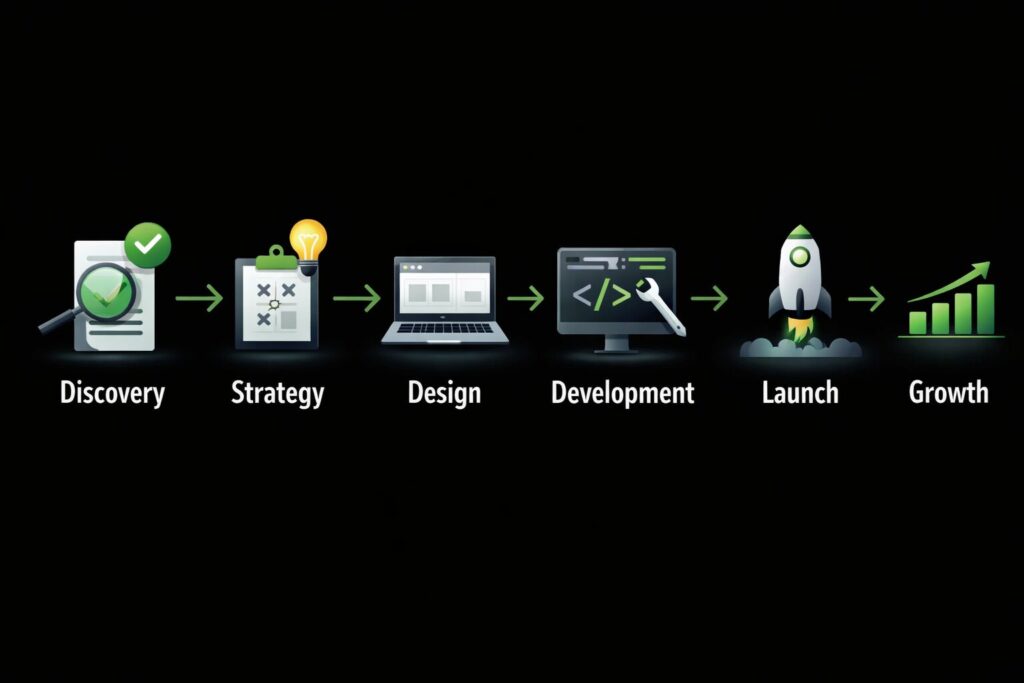
A professional website project should follow a structured process.
When someone contacts us looking for a website, the first step is always understanding their business.
We talk about:
- their goals
- their vision
- what makes their business unique
- what they want the website to achieve
Once we understand the business, we help structure the website — deciding what pages are needed and how the information should be organized.
Clients can provide their own content if they prefer, but we often help guide the content structure based on the information they share with us.
From there we move into the design and development phase. During this time we provide updates so the client can see how the project is progressing.
Once the website is ready, the client reviews everything and we go through revision rounds if needed.
After launch, we also provide tutorials so clients understand how their website works and how they can make updates themselves if they choose to manage it independently.
Final Thoughts
Choosing the right website designer is about much more than design.
The right designer should:
- understand your business
- communicate clearly
- know the craft of web development
- have a proven track record
- Build a website that supports your goals
When these elements come together, your website becomes more than just an online presence.
It becomes a tool that builds trust, attracts clients, and supports the long-term growth of your business.