
The Website Does the Work Before You Do
A business owner in Kanata needs a new accountant. A family in Barrhaven is looking for financial planning help. A self-employed professional in Centretown needs tax and bookkeeping support.
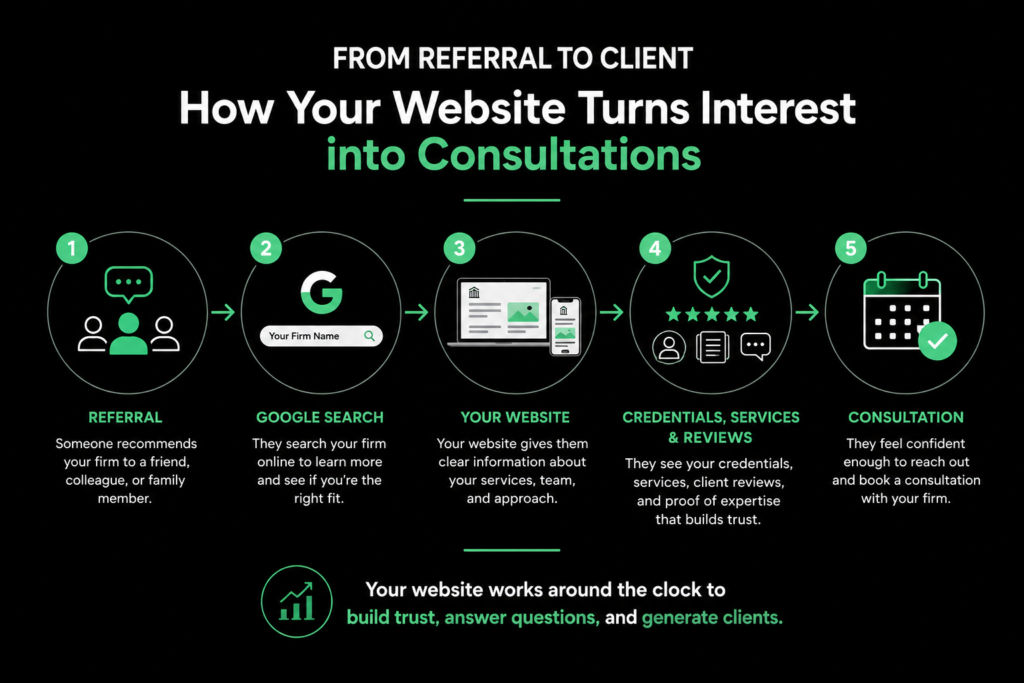
They may receive a referral. Before calling, there is a reasonable chance they will still look the professional up online.
What do they find?
An outdated website with no services listed? No team profiles, no credentials, no indication of who the firm actually works with? No clear way to request a consultation?
Or a website that immediately communicates who you help, what you do, why you are qualified, and how to take the next step?
For accountants, CPAs, bookkeepers, and financial professionals in Ottawa, the website’s primary job is not simply to look professional. It needs to reduce uncertainty and build enough trust that a prospective client feels confident making contact.
Web design for accountants Ottawa needs to accomplish something that generic small business website templates rarely consider: helping strangers make a high-trust decision about a professional they have never met, involving sensitive financial matters, before a single conversation takes place.
Why Websites for Accountants and Financial Advisors Are Different
Most small business websites need to answer one core question: can you do the work? Accounting and financial-services websites need to answer several harder questions simultaneously.
Trust is the central challenge. Prospective clients may be sharing sensitive financial information, making decisions about taxes, business structure, investments, retirement, or estate matters. The website is often the first opportunity to establish that the firm is credible, experienced, and the right fit.
Services are often misunderstood. Many prospective clients do not clearly understand the difference between a bookkeeper and a CPA, between a financial advisor and a financial planner, or between tax preparation and tax planning. The website needs to explain what the firm does in terms that make sense to a prospective client who is not a financial professional.
Referrals are not enough on their own. Even primarily referral-driven firms benefit from a strong website. A referral may bring someone to search the firm’s name. The website still has to give them enough confidence to contact you. One thing I look for immediately on a professional-services website is whether I can understand who the firm actually helps, and whether the person or team handling my account is clearly identified.
Credentials matter, and their absence creates doubt. A prospective client looking for a CPA to handle their corporate tax wants to see that the professional holds appropriate qualifications. Credentials buried in a generic About page, or missing entirely, create uncertainty at exactly the moment when trust matters most.
Client relationships often span years. Accounting and advisory relationships are not one-time transactions. A website that communicates long-term commitment, depth of service, and a genuine understanding of the client’s situation supports the kind of relationship a prospective client is hoping to find.
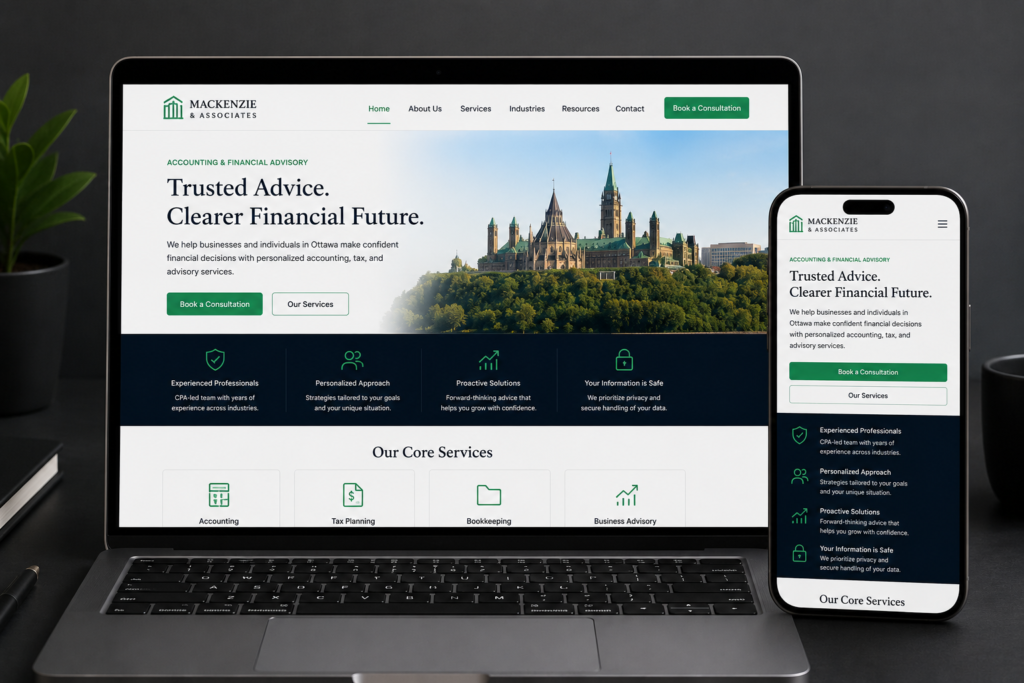
An effective website for an accounting or financial-services firm immediately communicates who the firm helps, what it offers, the team’s qualifications, and how to take the next step.
What Prospective Clients Want to Know Before Contacting You
A good website answers important questions before the consultation begins. Visitors evaluating an Ottawa accountant or financial professional typically want to know:
- Do you provide the specific service I need?
- Do you work with businesses or individuals like me?
- Are you accepting new clients?
- Where are you located? Can we work remotely?
- What qualifications does the person handling my account hold?
- Who will actually be working on my file?
- What industries do you understand?
- How long have you been practising?
- What happens at the first consultation?
- How do I get in touch?
A website that answers these questions clearly and directly removes the friction that causes prospective clients to move on to the next result. One mistake I see with professional-services websites is that they are written for industry peers rather than prospective clients. Jargon that makes sense internally often creates confusion externally.
 A referral brings someone to search your name. The website then needs to confirm your credentials, explain your services clearly, and make the next step obvious.
Web Design for Accountants Ottawa: Must-Have Pages
Home
The homepage should immediately communicate who you help, what you provide, where you operate, why someone should trust you, and what they should do next. Credentials, a clear service summary, and a consultation call to action should be visible without scrolling.
About the Firm
This page should go well beyond generic corporate history. Explain the firm’s experience, approach, the types of clients it works with, and what makes it a good fit for the people it serves. Avoid placeholder language about “commitment to excellence” that could describe any professional services firm anywhere.
Team Profiles
For accounting and financial-service firms, individual team profiles are one of the most important pages on the website. Prospective clients want to know who will be handling their file. Profiles should include education, professional designations, areas of focus, years of experience, professional memberships where applicable, and languages spoken. A professional headshot is essential. A brief personal note humanises the profile beyond a CV listing.
Never fabricate or exaggerate credentials. If a team member holds a CPA designation, that should be clear. If they do not, it should not be implied.
Accounting Services Overview
A clear summary of the full range of services offered, with links to individual service pages.
Individual Service Pages
Each major service should have its own dedicated page rather than being listed in bullet points on a single Services page. Individual pages improve how prospective clients understand each service, support internal linking between related services, and allow each page to be optimised for the specific search that person is making.
Examples of individual service pages where actually offered:
- Corporate and small business accounting
- Personal tax preparation
- Corporate tax planning
- Bookkeeping services
- Payroll administration
- Financial statement preparation
- Tax planning and advisory
- Cloud accounting setup and support
Individual service pages also improve the relevance of any Google Ads campaigns and the SEO performance of each specific service offering. Our post on what a business website should include covers the structural logic behind dedicated service pages in more detail.
Industries Served (Where Relevant)
If the firm genuinely specialises in serving specific industries such as construction, healthcare professionals, professional services, restaurants, real estate, or non-profits, this page helps prospective clients from those sectors recognise that the firm understands their situation. This page should only be created where genuine specialisation exists.
Resources or Blog
Educational content demonstrates expertise and supports SEO. Potential topics are covered further below.
FAQ
Answers common pre-consultation questions and reduces unnecessary phone enquiries.
Contact and Consultation Request
The contact page should include a phone number, email, physical address or service area, and a simple consultation request form. The form should not ask for sensitive financial information at this stage.
Privacy Policy
Required for any website collecting information through forms. Firms handling personal information have obligations under applicable privacy legislation. The Office of the Privacy Commissioner of Canada provides guidance on these obligations.
Financial Advisor and Financial Planner Websites
Financial advisors, financial planners, investment advisors, and wealth-management professionals have website needs that overlap with accounting firms but with important differences.
It is important to note that financial-professional titles in Ontario are not interchangeable and are not all regulated the same way. The titles “Financial Planner” and “Financial Advisor” have regulated meaning in Ontario under the Financial Professionals Title Protection Act, 2019. Requirements around the use of these titles, qualifications for using them, and what regulatory body governs them may vary depending on the specific services a professional provides.
For specific guidance on title use and regulatory requirements, professionals should consult primary authoritative sources including the Financial Services Regulatory Authority of Ontario (FSRA), the Ontario Securities Commission (OSC), the Canadian Investment Regulatory Organization (CIRO), and FP Canada where applicable.
This article does not provide compliance or legal advice. Professionals should confirm that their website’s use of titles, credentials, service descriptions, testimonials, and any marketing language is consistent with the requirements that actually apply to them.
A financial advisory website typically needs to include: a clear homepage, advisor profiles, a Who We Help or Ideal Client section, individual service pages (financial planning, retirement planning, business owner planning, estate planning coordination where applicable), educational resources, a contact page, a consultation booking option, and regulatory disclosures or disclosure documents where required.
Trust Signals Matter More in Financial Services
Design alone creates an impression. Evidence creates trust.
A polished website with no specific information about the professionals behind it cannot compensate for the absence of genuine trust signals. Prospective clients evaluating a financial professional are making a decision that may involve sensitive documents, significant assets, and an ongoing relationship.
Trust signals that carry real weight in this context include:
Professional headshots. A professional photograph of the actual person who will handle the file. Not stock imagery of strangers in suits.
Detailed team biographies. Specific background: where the professional trained, how long they have been practising, what types of clients they focus on, what professional memberships they hold.
Credentials presented accurately. If a professional holds a CPA designation issued by CPA Ontario, that should be stated clearly. Other designations should be presented with equal specificity. Never imply credentials that are not held.
Transparent contact information. A real address, a real phone number, and clear information about how client communication is handled.
Office photography. Images of the actual office environment give prospective clients a concrete sense of the firm.
Languages spoken. In Ottawa, noting that services are available in French and English, or in additional languages, is a meaningful differentiator for a significant portion of the local client base.
Google reviews where appropriate. Reviews visible through the Google Business Profile can be a trust signal for prospective clients researching the firm. Whether and how reviews can be solicited or displayed may be subject to the professional conduct rules of the relevant governing body.
Local SEO for Accounting and Financial-Services Firms in Ottawa
Accounting and financial-services searches carry strong local intent. A business in Barrhaven looking for a bookkeeper is typically looking for someone in Ottawa. A family in Nepean looking for a financial planner is not searching nationally.
Effective local SEO for these firms includes:
Google Business Profile optimisation. A complete, accurate GBP profile with the firm’s services, correct address, hours, and a consistent review collection process. Our Google Business Profile optimization guide covers every element of a well-maintained profile.
Individual service pages with location context. Service pages that naturally reference Ottawa and the specific types of clients served give Google clear signals about geographic relevance.
NAP consistency. The firm’s name, address, and phone number should be identical across the website, Google Business Profile, and any directory listings.
Content that reflects Ottawa market context. Blog content addressing tax deadlines relevant to Canadian businesses, references to CRA requirements specific to Canadian taxpayers, and content addressing the needs of Ottawa-area clients gives the site stronger local relevance than generic financial content.
For a broader picture of how local SEO works for Ottawa professional-services businesses, our guide on how to rank higher on Google Maps in Ottawa covers the ranking factors that apply across all local businesses including professional-services firms.
Accountant Website Design Should Make Services Easy to Understand
Financial terminology creates friction. Prospective clients who do not understand the difference between “assurance engagements” and “compilation engagements” will not know whether the firm offers what they need.
A more useful framing clarifies what the service actually does for the client:
Instead of: “We provide notice-to-reader financial statements.”
Consider: “We prepare financial statements that help small business owners understand where their business stands financially and meet the requirements of lenders or investors.”
Service pages written in plain English reduce the barrier between a prospective client recognising they need help and deciding to contact the firm. Our guide on how to write website copy that converts covers how to make professional services content clear and client-focused.
Privacy, Security, and Website Considerations
Accounting and financial-services websites collect personal information through consultation request forms, newsletter sign-ups, and client intake processes. Firms operating in Canada have obligations under applicable privacy legislation, including the Personal Information Protection and Electronic Documents Act (PIPEDA) for many commercial activities. The Office of the Privacy Commissioner of Canada provides guidance on these requirements.
Some specific website considerations worth noting:
Forms should collect only necessary information. A consultation request form does not need detailed financial information at the initial contact stage. Asking for sensitive data through a basic web form raises security and privacy concerns.
SSL and HTTPS are baseline requirements. Any website collecting personal information should operate over a secure connection (HTTPS). This is also a basic factor in how Google evaluates website trustworthiness.
Client portals and document exchange. Where firms exchange documents with clients electronically, this should happen through secure, purpose-built platforms rather than unencrypted email or general web forms.
Accessibility. Professional-services websites should implement fundamental accessibility practices including sufficient colour contrast, proper heading structure, and descriptive image alt text. Current guidance is available through the Web Content Accessibility Guidelines (WCAG). For a practical overview of how accessibility connects to responsive design, our post on what is responsive web design covers the performance and usability foundations.
Content Marketing for Accounting and Financial-Services Firms
Educational content is a genuine opportunity for accounting and financial-services professionals. Prospective clients often research their questions before approaching a professional.
Potential topics for accountants:
- When does a small business in Ontario need to hire an accountant?
- Bookkeeper versus accountant: what is the difference?
- What records should a Canadian small business keep for tax purposes?
- Tax planning versus tax preparation: why the distinction matters
For any content touching on tax rules, CRA requirements, or specific regulatory matters, consult and link to authoritative primary sources including the Canada Revenue Agency. Do not publish specific tax advice without appropriate professional guidance.
Potential topics for financial advisors and planners:
- What does a financial planner do?
- How financial planning works: an overview for Canadians
- Questions to ask when choosing a financial advisor
- What happens during an initial financial planning consultation?
Educational content that helps prospective clients understand their options demonstrates expertise before the first meeting and supports long-term SEO by creating content that matches real search queries. Our guide on local SEO for small business explains how content supports local search visibility over time.
Common Website Mistakes Accountants and Financial Advisors Make
Generic stock photography. Photographs of strangers shaking hands in offices do not help a prospective client understand who they would be working with. Real photographs of the actual team and office make a significant difference to how the website is perceived.
No individual professional profiles. Listing credentials in a generic About page rather than dedicated individual profiles makes it harder for prospective clients to understand who will handle their file.
Services listed without explanation. A list of service names without any description of what each service involves or who it is for does not help a prospective client understand whether the firm is the right fit.
Unclear target audience. A website that speaks to everyone often connects with no one. A firm that primarily serves small businesses should communicate that clearly, rather than presenting a generic description that makes the same vague claim as every other firm in the city.
No consultation path. A website that explains the firm’s services but provides no clear way to take the next step relies on the prospective client to figure out how to proceed. A clear consultation request process reduces that friction.
No local SEO foundation. A website with no Google Business Profile connection, no location references in page content, and no NAP consistency misses the local search audience entirely.
Outdated information. Outdated tax rates, superseded regulatory references, or former team members still listed damage credibility and may create compliance concerns depending on the context.
Poor mobile experience. Most searches happen on mobile devices. A website that is difficult to navigate on a phone loses visitors before they read the first paragraph.
An effective professional-services website requires all six components working together: trust signals, clear services, local SEO, educational content, security, and a clear consultation path.
Basic versus Growth-Focused Accounting Website
| Basic Website | Growth-Focused Website |
|---|---|
| Generic homepage | Clear positioning and target audience |
| One services page | Individual service pages with explanations |
| Short About section | Detailed professional profiles with credentials |
| Contact form | Consultation journey with clear next steps |
| Minimal Google presence | Active local SEO strategy and GBP |
| Generic content | Educational resources relevant to Ottawa clients |
| Stock imagery | Real team and office photography |
| No performance tracking | Conversion tracking set up from launch |
Not every practice needs the full right-hand column immediately. The right website matches the firm’s current growth strategy and planned trajectory. Our post on Ottawa web design versus DIY covers how to think about matching website investment to business stage.
Website Checklist for Accountants and Financial Advisors
Positioning:
- [ ] Can visitors immediately understand who the firm helps?
- [ ] Is the firm’s target client clearly communicated?
Services:
- [ ] Does every major service have its own page with a plain-English explanation?
- [ ] Are services written for prospective clients rather than industry peers?
Trust:
- Does each professional have a detailed individual profile?
- Are credentials presented accurately and clearly?
- Are professional designations and memberships listed correctly?
Conversion:
- Is the consultation or contact process obvious?
- Is a phone number and email visible without searching?
Local SEO:
- Is the site connected to an active Google Business Profile?
- Is the firm’s NAP consistent across the website and all directories?
- [ ] Does content reference Ottawa and relevant service areas?
Content:
- Are educational resources accurate and current?
- Is tax or regulatory information sourced to appropriate primary sources?
Privacy:
- Does the website have a current privacy policy?
- Do contact forms collect only necessary information?
Security:
- Is the website served over HTTPS?
- Are sensitive documents exchanged through secure platforms rather than general forms?
Mobile:
- Is the website easy to use on a phone without zooming or horizontal scrolling?
- Is the phone number tappable and visible on mobile?
Accessibility:
- Are fundamental accessibility practices implemented (contrast, headings, alt text)?
Frequently Asked Questions
How much does an accountant website cost in Ottawa?
A professionally designed website for an Ottawa accountant or financial-services firm typically ranges from $3,000 to $8,000 or more depending on the number of professionals profiled, the number of individual service pages required, whether copywriting is included, whether bilingual content is needed, the level of local SEO built in, and whether any integrations such as appointment booking or client portal connections are part of the scope. Firms with a larger service range, multiple team members, and industry specialisation pages sit at the higher end of that range. Our website pricing guide provides a broader breakdown of how scope affects cost.
What should an accounting firm website include?
At minimum: a homepage that clearly identifies who the firm helps, individual team profiles with accurate credentials, dedicated pages for each major service offered, a clear way to request a consultation, a privacy policy, and contact information including a physical address or service area. For firms that want to attract clients through Google search, local SEO foundations and educational content add significant value over time.
Do accountants need SEO?
If attracting new clients through Google search is a business goal, then yes. Many Ottawa accounting and financial-services clients search for help before making contact, even when a referral is involved. A website without proper local SEO foundations, an active Google Business Profile, and service-page structure will be less visible to those searchers than competitors who have invested in these areas.
Can a website help an accountant get more clients?
Yes, in several ways. A well-structured website with clear service explanations, strong team profiles, and a clear consultation path converts referrals and search traffic into enquiries more effectively than one with vague information and no clear next step. Educational content establishes expertise for prospective clients who are researching before making contact. And local SEO creates visibility for searches the firm would not otherwise capture.
What should a financial advisor website include?
A financial advisory website should include: a homepage that communicates the type of clients served and the services offered, an advisor profile with accurate credentials and designations, service pages for each financial planning area the practice provides, a clear Who We Help or Ideal Client section, a consultation booking or enquiry path, and any required regulatory disclosures. Titles and credential representations should be consistent with the requirements of the relevant governing body, whether FSRA, CIRO, FP Canada, or another applicable regulatory organisation.
Should accountants have online appointment booking?
It can be valuable, particularly for firms that offer initial consultations. A simple appointment booking integration reduces friction for prospective clients who prefer not to call and captures enquiries outside of office hours. The form or booking system should collect only the information needed to prepare for the consultation rather than asking for sensitive financial details at the initial stage.
The Website Is the First Professional Impression
For accountants, CPAs, bookkeepers, and financial professionals in Ottawa, the website’s job is not simply to exist. It needs to help prospective clients understand what the firm does, understand who it helps, verify the credentials of the people who will handle their file, trust the firm’s expertise, and know exactly how to make contact.
Web design for accountants Ottawa requires all five of those outcomes working together: a professional website, clear trust signals, a local SEO foundation that creates visibility in Ottawa searches, educational content that demonstrates expertise before the first meeting, and a straightforward consultation journey that makes the next step obvious.
At Ottawa Web Genius, we build websites for Ottawa professional-service businesses that make it easier for prospective clients to understand services, trust expertise, find the firm through local search, and take the next step. We design around business goals and client experience rather than aesthetic templates.
Explore our web design services or view our pricing to understand what a professional-services website built for Ottawa’s market looks like.